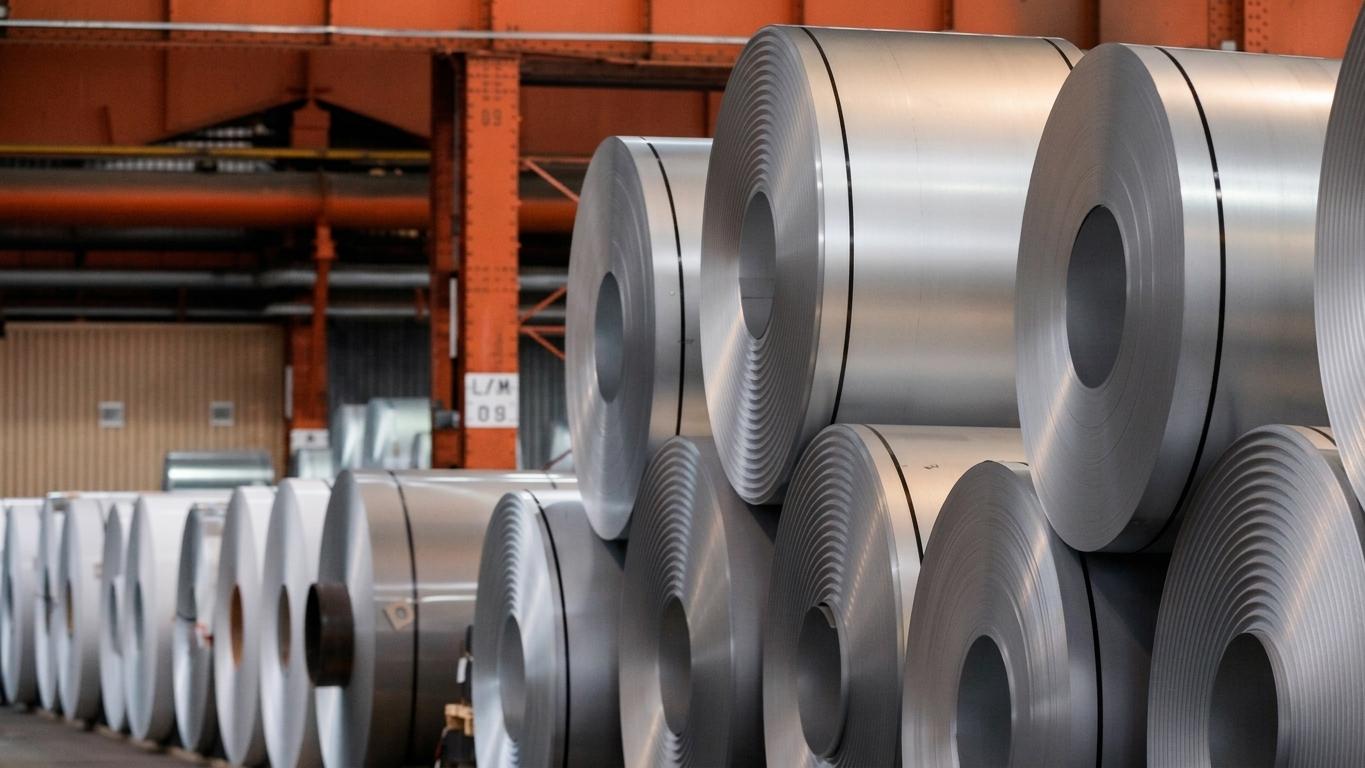
BaoAM® is Aluzinc with magnesium. The same base everyone knows, with a coating that stands up to Icelandic weather far better.
Icelandic buildings are under constant load. Salt, wet and wind work on the cladding all year round, and that load has been measured. The Icelandic Building Research Institute exposed bare steel panels at fifteen sites around the country for a full year and measured what had gone. In Vestmannaeyjar 36.1 µm disappeared in one year, at Svartsengi 35.3 µm and in Reykjavik 20.7 µm. Up at Kverkfjoll, far from the sea, 1.5 µm.
Our corrugated sheet is 0.6 mm thick, which is 600 µm. It is not the steel itself that decides how long a roof lasts in those conditions, it is the coating on top of it.
Aluzinc is steel hot dipped in a melt of 55% aluminium, 43.5% zinc and 1.5% silicon. The same material is sold as Galvalume® by BIEC International and ZINCALUME® by BlueScope, and Aluzinc® is a trademark of ArcelorMittal. The standards are EN 10346 in Europe and ASTM A792 in the United States.
The aluminium in the coating forms a dense barrier that keeps water and salt off the steel. The zinc is sacrificial, dissolving ahead of the steel wherever the coating is broken and holding the rust back. The silicon does neither. It restrains a brittle intermetallic layer that would otherwise grow between coating and steel.
Aluzinc is the most common steel cladding in Iceland. Its coating is quoted in grams per square metre, counting both sides together. AZ150 is the ordinary grade and AZ185 is the heaviest sold here.
The coating protects a flat surface, but it cannot cover what has been cut. At a cut edge, in a screw hole or in a scratch from installation the steel stands bare, and the zinc is all that is left to protect it. It only reaches a short way in from the edge, and in Aluzinc the zinc is barely a third of the coating.
It matters more here than in most places, because in Iceland everything is cut to size. Every sheet is cut to length, every flashing is folded and trimmed, and a roof carries twelve to fourteen fasteners per square metre. Rust almost always starts at an edge or a screw, not in the middle of a sheet.
BaoAM® is the same Aluzinc, except that magnesium is added to the melt. It is 47 to 57% aluminium, 1 to 3% magnesium, 1 to 2% silicon and the remainder zinc.
The magnesium creates two new compounds inside the coating. Magnesium zinc (MgZn2) sits near the top, where it is needed first, and gives a denser, tougher corrosion product at cut edges and scratches. Magnesium silicide (Mg2Si) lies lower down, close to the steel, acting as a barrier in the zinc-rich channels and closing off the routes to the steel. Later in the life of the cladding it also activates the aluminium-rich areas of the coating into the sacrificial work they otherwise do poorly.
This is not a new idea waiting to prove itself. BlueScope has made the same alloy since 2013 as ZINCALUME® with Activate®, after seventeen years of testing, and the same chemistry lies behind the ZM coatings that EN 10346 now covers.
Baosteel tested BaoAM alongside ordinary Aluzinc, at the same coating weight and in the same tests.
More hours is better.
Again, more hours is better.
The edge was still clean at 780 hours, by which time the Aluzinc had begun to rust.
The manual plots cut-edge performance against the Zn-ratio index, the coating weight on both sides divided by the thickness of the sheet. Our corrugated sheet carries 180 g/m² on 0.6 mm, which puts it at 300. At that point the chart in the manual shows about 1,260 hours to red rust for BaoAM against about 750 for Aluzinc. On a flat surface the gap is smaller. There the manual gives BaoAM more than 50% longer on average, and after two years of outdoor exposure its weight loss was about a third lower.
This does not rest on the producer alone. BlueScope makes the same alloy in Australia and reaches the same conclusion in its own testing. In their results AM125 protects cut edges better than AZ150, even though it is the lighter coating.
| Property | Value |
|---|---|
| Material | Steel with a hot dip Aluzinc-magnesium coating (BaoAM®) |
| Coating type | AM, that is aluminium, zinc and magnesium in the coating |
| Thickness | 0.6 mm |
| Coating weight | 90 g/m² per face, 180 g/m² in total |
| Coating thickness | About 24 µm per face |
| Zn-ratio index | 300 |
| Standard | Q/BQB 425 |
| Producer | Baosteel |
For comparison, ordinary Aluzinc is AZ150, or 75 g/m² per face, and the heaviest sold here is AZ185. Our coating sits in the same weight class as the heaviest on the market, in a better alloy.
Baosteel BaoAM manual, standard Q/BQB 425 (PDF)The Icelandic building regulation sorts conditions into five corrosion classes and sets a protection requirement for each. Class 3, inland in the north and east, requires 115 µm of zinc. Class 4, where moisture and sea salt are considerable, requires the same coating, plus paint on top where that thickness cannot be reached. Class 5 adds a further 150 to 200 µm of paint.
Those requirements are written for structural steel galvanised after fabrication, not for thin cladding coated on a continuous line. But the classification says something about the country. Measurements place Iceland in class 3 to 4 for zinc, and a classification made from weather data alone puts it as high as class 5.
Three things account for most of it, and all of them are Icelandic.
Salt. Chloride deposition averages 19.8 mg/m² per day in Reykjavik and reaches 53 mg/m² in the worst months. The prevailing wind is southerly and the salt is carried clear across the country; after a southerly storm salt deposits are found on structures on the north coast.
Wetness. Time of wetness, meaning above 0 °C and above 80% humidity, ranges from 1,449 hours a year to 6,324. The higher figure is 72% of the year.
Sulphur. Air pollution is low in Iceland, but not beside geothermal steam. The test site at Svartsengi recorded the second highest corrosion in the country.
No cladding suits everywhere. The producer is clear about where this one does not belong, and what follows comes straight from the manual.
Avoid direct contact with wet concrete and wet timber, and with lead, copper and graphite. Alkaline wet attacks the coating.
A roof in this material needs a fall, so that water does not stand on it.
Cut in the workshop rather than on site, and never with an electric saw. Glowing iron filings burn into the coating.
Aluzinc is not recommended for uninsulated livestock buildings. Decomposition gases from animal waste attack the alloy in the coating, and that holds for Aluzinc with magnesium too.
BaoAM is Aluzinc with magnesium. The same base, a better alloy.
The coating is 90 g/m² per face, the heaviest the material is made in.
The magnesium works exactly where Aluzinc gives way, at cut edges, at screws and in scratches.
In the producer tests it lasts roughly twice as long as Aluzinc of the same coating weight, and a second producer of the same alloy reaches the same conclusion.
It counts for a lot here, because the weather never gives the cladding a break.
Baosteel, BaoAM: Hot-Dip Aluminum-Zinc-Magnesium Alloy Coated Steel, standard Q/BQB 425
Icelandic building regulation 112/2012, article 8.4.2 on corrosion classes for steel
GalvInfoNote 1.4, 55% Aluminum-Zinc Alloy-Coated Steel Sheet, International Zinc Association
BlueScope TB-10, Cut edge and bend protection of next generation ZINCALUME steel

